Oriana (5)

At dawn on the twenty-third of October, Oriana sat in the kitchen of the Musetti household, her back warmed by the glow of the lit fireplace. Her family had already ventured into the fields to complete preparations for winter. Parents, brothers, sisters, Svanèn, and the other laborers.
While she remained alone in the kitchen, having breakfast as usual.
Since she was a child, ever since the first signs of her talent emerged, Oriana had been excluded from the family’s regular activities. She had participated in some tasks for fun, but eventually, she grew old enough to be entrusted to Sora Melandra, and the matter was not discussed further. She had grown up alone.
She had freshly milked milk, still warm from the cow’s udder, a pancake made with chestnut and barley flour, topped with a slice of Lunigiana cheese, with its delicate flavor complementing the sweetness of the carob compote.
Melandra had completed her task and returned to Spezia, awaiting another family to request her services. Oriana was even more alone now. A mage always is. She could have all the men she wanted, but not a husband, not a family.
She heard a knock at the door and a shout from outside:
“Hey, Oriana, are you ready? If we keep up a good pace, we can reach the castle before noon!”
She at least had friends. Flavio had offered to accompany her to Gaggio; she met him outside. He was covered in a large black cloak, a rain hat, and boots, as it was a cold morning. She also wore traveling clothes: a red cloak with a hood, woolen stockings secured with straps around her thighs, and a shoulder bag containing the beautiful dress she would wear at the castle.
They passed through the willow forest so Oriana could bid farewell to her relatives at work. First, they passed the area of white trees, used for wood, then they skipped over the irrigation canal where it pooled in spring, adorned with yellow celandine flowers. They ventured into the grove of purple willows, bathed in otherworldly light. Then they climbed over the property fence and found themselves on the road, bustling with busy people. Some carried bundles on their shoulders, some led draft horses hitched to carts, and others mowed grass at the edges, each receiving a greeting.
Only when they reached the crossroads and ascended the road climbing to their destination, did they find themselves alone, amidst the orange leaves and the gray clouds.
“You’re so kind to accompany me. Won’t your folks be upset that you’re out and about?” Oriana asked.
“No. Now that I’ve fought, my father doesn’t give me chores. He’d rather I go to Genoa to become a crossbowman. It’s all straightforward for him: two years of service, good pay, either you end up dead or you come back with money to marry.”
“Wouldn’t you want that?”
“I want to see the world and play my hurdy-gurdy. I want to join a company of wandering musicians.”
“And then? You wouldn’t come back?”
“I don’t know. I can’t know what will be.”
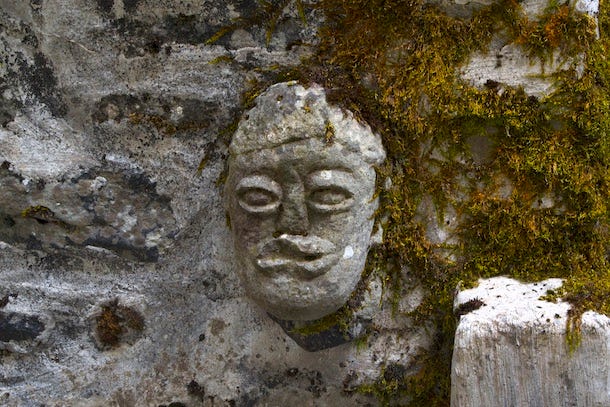
Thus conversing, they arrived where the path passed between two large stones, engraved with faces. They’re called Faciòn in those parts, or Marcolfe, found everywhere guarding borders and entrances. As soon as they crossed that boundary and set foot in Gaggio’s lands, they saw the weather change abruptly: the sun pierced the clouds, and the air grew warmer.
“What about you? Why do they want you here? Will they be angry about the battle? What if they put you in prison?” Flavio inquired.
“You can’t imprison a mage after inviting her, and they’ve also given their word to the Mayor.”
“Let’s hope they keep their word,” he replied.
The forest flanking the road gave way to sheep pastures, carefully terraced and dominated by a small ravelin at the top of the road, beyond which stretched the market square and festival grounds. They crossed the ravelin’s door and the deserted square, passing then through the gate of the outer walls without anyone stopping them. Between the outer wall and the actual castle, there were the dwellings of servants and knights, soldiers and artists. The narrow streets were paved and filled with courteous, well-dressed, smiling people speaking unfamiliar languages. It was as if King Charles’s court had relocated to that remote corner among the Apennines.
But courts cost money, and all those people didn’t seem capable of growing their own food. Oriana didn’t understand politics or economics, but she still intuited why they might have to sack the valleys.
Finally, they found a steward waiting for them at the inner gate, who apologized profusely for not having come to meet them, saying he hadn’t recognized them because he expected the important guest to arrive with a much larger entourage. They didn’t know they were important, but it must have been true because both of them were assigned accommodations of unparalleled luxury, complete with feather mattresses and tubs for bathing in heated water. They had to hurry to settle in because the banquet was about to begin. That’s exactly what the steward had said: banquet, just like in fairy tales. At that point, Oriana had no thoughts of battles or conspiracies. Her only fear, indeed terror, was that her party dress, bought two years earlier from a man claiming to be from Rome, wouldn’t measure up.